| PHYS 326 - QUANTUM MECHANICS - II |
|---|
| Semester: | Spring 2026 | |||
|---|---|---|---|---|
| Instructor: | Cemal Yalabık | |||
| Office: | Room SA-228 | Phone 1316 | ||
| Office Hours: | Fridays | 13:00 - 14:00 | Room SA-228 | |
| All other times | (if available - call 1316 to check) | Room SA-228 | ||
| Assistant: | Abdulhay Can Kara | |||
| Homework: | Policy | Assignments | ||
| Exams & Grading: | "Cheat sheets" will not be allowed during the exams,
but you will be provided with sufficient information for solving the
problems without memorization.
There is an attendance requirement for this course: A student may not miss more than 6 hours of class in order to pass the course. Further absences may be compensated by completing assignments which will take much longer time than the corresponding class time. | |||
| First Exam (Solutions) | % | Tuesday, March 10 | 15:30 - 17:20 | |
| Second Exam (Solutions) | % | Friday, April 10 | 10:30 - 12:20 | |
| Final Exam (Solutions) | % | Monday, May 11 | 12:00 - 15:00 (Room A-329) | |
| Homework/Quiz/Participation | % | |||
| Course Schedule: | ||||
| First meeting: Friday, Jan. 23, 10:30 - 16:20 in Room | ||||
| Tuesdays | 15:30 - 16:20 | Room | ||
| Fridays | 10:30 - 12:20 | Room | ||
| Recitation: | Tuesdays | 16:30 - 17:20 | Room | |
| Textbook: | ||||
| Introduction to Quantum Mechanics by Griffiths | ||||
| Recommended: | ||||
| Introduction to Quantum Mechanics by Griffiths and Schroeter | ||||
Homework: There will be weekly homework assignments in this course.
Problem solving sessions: Occasionally, we will hold problem solving sessions, during the recitation hour. A problem will be asked, and all students will be expected to solve the problem on their own. You can use your textbooks or notes, but may not discuss the problem with your friends. You may discuss it with the instructor. You will have to complete the solution and hand it in during the session, your solution will be graded as a quiz.
You can view your grades through the Stars system.
|
FZ Policy In order to get a D grade from this course, a student must show an overall achievement level of %. An important part of this achievement must be accumulated through regular studying, before taking the final exam. The student must demonstrate this by accumulating sufficient pre-final points from the first and second exams such that the overall average will be over % even if the remaining assessment grades (i.e. Homework+Quiz+Final) average to less than or equal to twice this pre-final grade. (Also, see below for the attendance requirement.) Therefore a student cannot get a D grade if the pre-final achivement level is below % from the first and second exams. This means, a student will receive the FZ grade (and will not be able to take the final exam) if the average is lower than % from the first and second exams! (If the average is %, the student will need to receive from the remaining assesments [Homework+Quiz+Final] to get a D grade.)
|
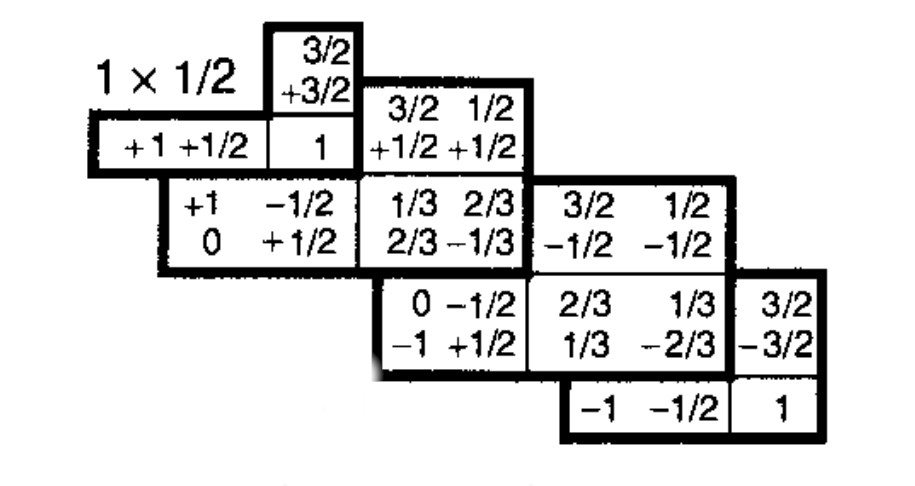
| Week (Monday) | Subject | Exam | Addition of Angular Momenta#1 | Time independent Perturbation Theory#2
Variational Principle
- applications Time-dependent perturbation theory Time-dependent perturbation theory - applications No Friday class Time-dependent perturbation theory - applications | |
|---|---|---|---|---|---|
Relevant links: