This first homework is to test your knowledge of basic calculus which will be needed throughout this course.
It is intended to give you an idea about how well your math background is in relation to this course.
If you are experiencing major problems in carrying out these operations, then you have defficiencies in the knowledge
prerequisite to this course. Chances are you will have trouble in following this course, and will not be able to
perform well in the exams. I suggest you do a quick review of the relevant material.
Wavefunction for a particle is given as

             {     A exp(iqx -x2/a2) for x<0
  Ψ(x,t=0) = {
             {    A exp(-ikx -x2/b2) for x>0

where A is the normalization constant and k,q,a,b are positive constants with proper units.
We also have a>b  and  q>k.

Find the following quantities:

  (a) The normalization constant A
  (b) <x>
  (c) <P>
  (d) Calculate the probability current j(x), plot and discuss its behavior.
A particle is in a one-dimensional quantum box of width a with infinitely high walls.

The box extends from x=0 to x=a.

It is given that the wavefunction at time t=0 is given as

             {  A  for a/4 < x < a/2
  ψ(x,t=0) = {
             {  0  otherwise

  (a) Find the normalization constant A assuming it is real and positive,

  (b) Find the expansion coefficients of ψ(x,t=0) in terms of the eigenfunctions of this system.

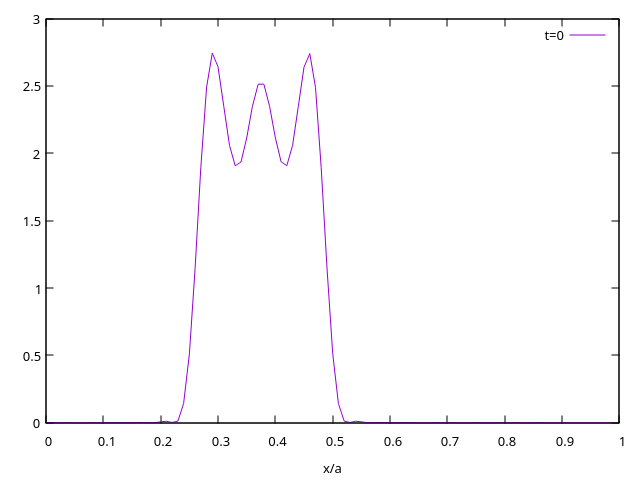
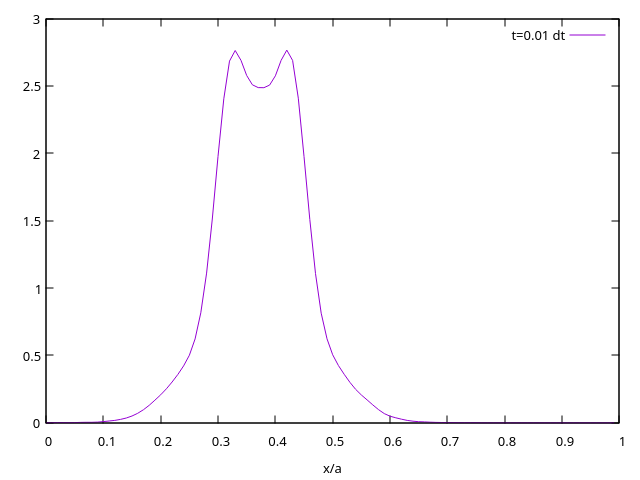
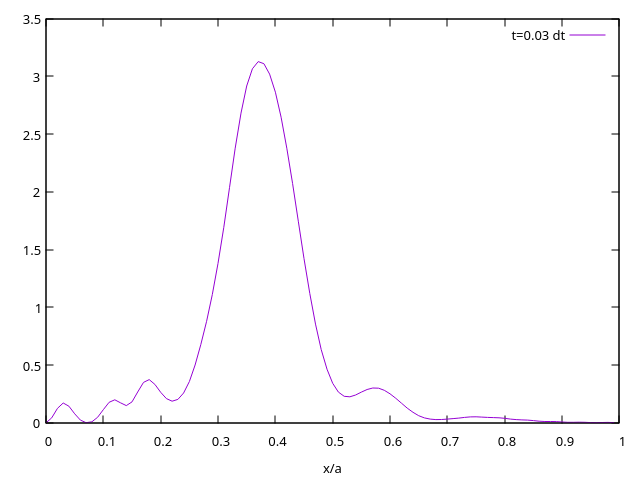
  (c) Obtain a computer plot of |ψ(x,t)|2 for values of t = 0, Δt, 2Δt, 3Δt for Δt =0.01ħ/E1
      where E1 is the lowest energy eigenvalue of the system.

      (Please include your computer code in the submission.)

      Here is what I get keeping 25 terms in the expansion:
      (Note that keeping even 25 terms does not give a very good representation of ψ(x,t=0).)
A particle is in a one-dimensional quantum box of width a with infinitely high walls.

The box extends from x=-a/2 to x=a/2. There is also a δ-function potential at the
center of the box so that the overall potential looks like

         {  ∞  for |x| > a/2
  V(x) = {
         {  αδ(x)   otherwise

  (a) Write down the form of the ground state wavefunction for x<0 and x>0.

  (b) Write down the form these solutions must obey due to the box walls and the δ-function.

  (c) Write down the equation from which the ground state energy may be determined, but do not attempt
      to solve this equation.
(a) Find the momentum-space wavefunction g(k) corresponding to the following wavefunction:

          {  A cos(πx)  for |x|<a/2
   Ψ(x) = {
          {  0           otherwise

(b) Find the transmission and reflection coefficients for a potential as a function
    incident particle wavenumber k for the following potential:

           {  0     for  x<0
    V(x) = {  αδ(x) at x=0
           {  Vo    for x>0.

    α and Vo are positive constants. Particles are incident from x=-∞.
(You may want to wait until after this Monday's class to start working on this assignment.
Given that a+ and a- are the harmonic oscillator raising and lowering operators.

Using the commutation relations, express the following so that the terms in the result are in the form
all a+ terms on the left and all a- terms on the right, as for example, (a+)3 (a-)3

(a) a- a+

(b) (a-)2 (a+)2

(c) (a-)3 (a+)3

(d) (a-)4 (a+)4

In parts (e), (f), (g) and (h), use the same expressions in parts (a), (b), (c) and (e)
to express them only in terms of constants and the number operator n = a+ a-
(i.e. with no a+ or a- in the final expression)
 (a) Given that the state of a particle in a harmonic oscillator potential
     at time t=0 is  ψ(x,0) = A [3uo(x) - 4u1(x)] where un(x) represents
     the n'th eigenstate of the harmonic oscillator.

     (i)   Determine the normalization constant A.

     (ii)  Find the time dependent wavefunction ψ(x,t)

     (iii) Find the time dependent averages <x> and <x2>

 (b) Repeat part (a) when ψ(x,0) = A [uo(x) + u2(x)]
The Hamiltonian of a three-state system is given as

  H = Eo (  |1⟩ 1 ⟨2|  +  |2⟩ 1 ⟨1|  +  |3⟩ 1 ⟨3|  )

where Eo is a constant with units of energy and  |1⟩ , |2⟩ and |3⟩ are the
eigen-kets of another operator in the same Hilbert space, and they form a
complete, orthonormal set.

(a) Construct the 3x3 matrix corresponding to the Hamiltonian in this basis.
    (i.e. find the matrix with elements Hij = ⟨i|H|j⟩ )

(b) Find its eigenvectors and eigenvalues.

The system is known to be in the state |ψ(t=0)⟩ = A (|1⟩ +|3⟩) at time t=0.

(c) Find the normalization constant A.

(d) Expand |ψ(t=0)⟩ in terms of the eigenstates of H.

(e) Find |ψ(t)⟩ for t>0.
(1) Consider the Hamiltonian matrix H of Homework 8

    (a) Construct the matrix exp(-itH/ħ)

    (b) Use the initial condition given in that problem and verify that |ψ(t)⟩ = exp(-itH/ħ) |ψ(0)⟩

(2) A particle moving in three dimensions has the potential V = Vx(x) + Vy(y)  where

            {  0  for  0<x<<a
    Vx(x) = {                    and   Vy(y) = ky2/2.
            {  ∞  otherwise

    Find the energy eigenstates and their eigenvalues.
Consider a spin-1 particle in a constant, uniform magnetic field in the z-direction with
magnitude Bo. Find the expectation value ⟨Sx⟩ as a function of time
if the spin state of the particle is known to be in the following states at time t=0:

(a) |1,1⟩ after an Sz measurement
(b) |1,mx=1⟩ after an Sx measurement
(c) |1,mx=0⟩ after an Sx measurement

You can use the eigenvectors |1,mz⟩ and |1,mx⟩ we found in class directly.