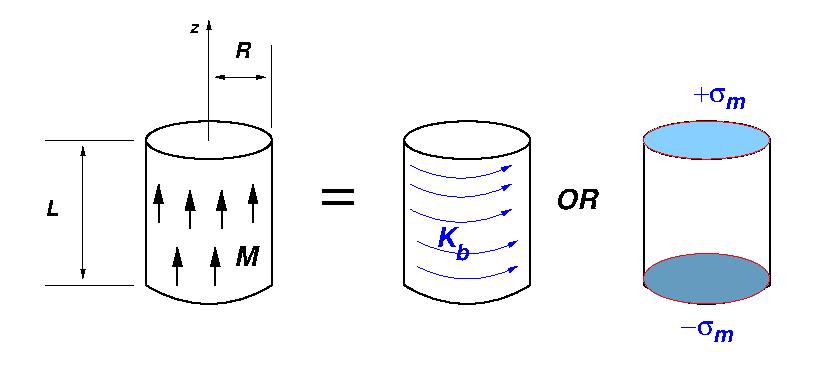
Consider a cylindrical bar magnet with radius R and length L. There are two ways to solve for the magnetic field:

One is to consider the bound surface current Kb on the surface ofthe cylinder

OR

alternatively you could consider the magnetic charge on the circular surfaces and find the magnetic scalar potential

(a) Find the magnetic field as a function of z due to the bound surface current.
    (This is effectively the finite selenoid problem we discussed earlier.)

(b) Find the scalar magnetic potential along the z-axis, due to the two (magnetically) charged disks.
    Differentiate the potential to obtain H, and from that, obtain the magnetic field.
    (Note that since the magnetic scalar potential has azimuthal symmetry, you can even find the
    fields off the z-axis with this method.)
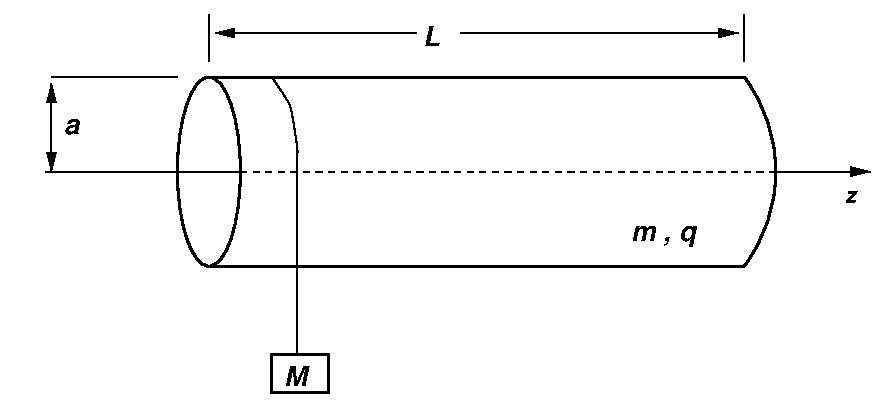
A long cylindrical shell with radius a is coaxial with the z-axis as shown in the figure.
The cylinder is free to rotate around the z-axis. It has a length L, mass m and carries a total
charge q distributed uniformly over it.

(a) Find the magnetic field at all regions of space when the cylinder is rotating with angular
    velocity ω.

(b) At time t=0, the cylinder is at rest. Then, it starts rotating, due to the torques acting on it.
    Note that the cylinder has an electric field acting on it due to the acceleration of the cylinder
    itself. It also has a mechanical torque acting on it due to the weight of mass M.

    Find the expression for the torque on the cylinder, and using that, find its angular velocity as a
    function of time.

(c) Find the
      o energy in the magnetic field
      o kinetic energy of the cylinder
      o the potential and kinetic energies of the mass M
    at time t and discuss your result.
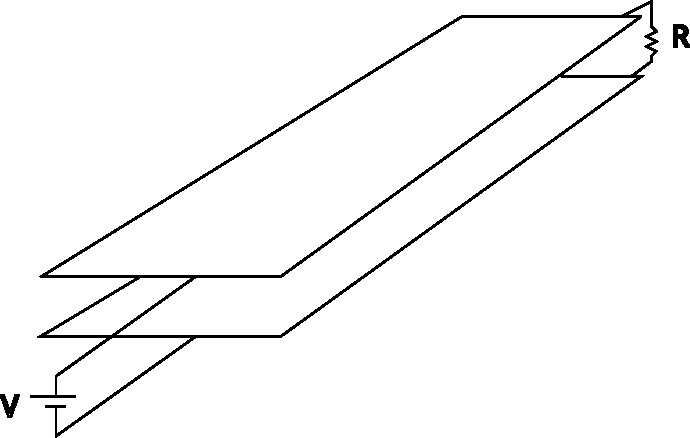
Two wide (width w) and long (length D) conducting parallel plates are separated a small distance (a) apart.
A potential difference V is applied to one end, and a resistor R is connected to the other end so that
a uniformly distributed current I = V/R flows uniformly along the length of the conductors.
Ignore the fringe fields, i.e. consider only the fields between the conductors to

 o find the electric field between the plates,
 o find the magnetic field between the plates.
 o Find the Poynting vector (magnitude and direction) between the plates.
 o Find the flux of this field through an area (perpendicular to the field) between the conductors.
 o Comment on your result.
(This was an exam question in Spring 2024 Phys 316.)
Two infinite line charges extend parallel to the z-axis. The line charge with charge per unit length +λ is at x=a,
while the other one with charge per unit length -λ  is at x=-a. (i.e. the two parallel line charges are a distance 2a apart.)

  (a)  What is the direction of the electric field on the y-z plane?
  (b)  Find the magnitude of this field on the y-z plane.
  (c)  We will now use the Maxwell tensor to determine the force per unit length between the line charges, integrating it
       on the $y-z$ plane. From symmetry, which element(s) of the tensor will be finite on the $y-z$ plane?
       Calculate these quantities.
  (d)  Carry out the integration to find the force per unit length acting on the line charge.
Consider a long cylinder of radius R and length D, co-axial with the z-axis. The cylinder carries a
volume charge density ρ (charge per unit volume) and rotates with angular velocity ω around the
z-axis.

  (a) Find the electric field E and the magnetic field B in space.

  (b) Find the Poynting vector and the corresponding momentum density ⅌ due to E and B.

  (c) Analyze the angular momentum density ℓ by studying the direction of r⨯⅌
      (where r is a vector from any convenient reference of your choice) decide on the direction
      of the total angular momentum. Find the total angular momentum in that direction.
      (Your calculation will be easier if you replace r⨯⅌ with a⅌ where a is the
      appropriate moment arm distance.)

  (d) Suppose now that the angular velocity is increasing linearly with time: dω/dt = α.
      This will generate an additional electric field due to changing B. Find this electric field E2.

  (e) E2 will producing a force on the charge density. Find the total torque due to the
      action of E2 on ρ.

  (f) Relate the results of part (c) and part (e).

  (g) Does E2⨯B contribute to the total angular momentum?
Two plane electromagnetic waves are traveling, electric fields of each described with
the phasor representation as En exp(i kn⋅r - iωt)   and the properties given below:

First wave:  E1 = iEo (𝒾 - 𝒿)/√2  k1 = ko (𝒾 + 𝒿)/√2
Second wave: E2 =  Eo 𝓀           k2 = ko (𝒾 - 𝒿)/√2

where 𝒾, 𝒿 and 𝓀 are the unit vectors in the x, y and z directions. Eo and ko are real constants
with appropriate dimensions.

  (a) Find the (real) electric field at the point (0,a,0).

  (b) Find the (real) magnetic field at the point (0,a,0).

  (c) Find the Poynting vector at the point (0,a,0). On the average, how much
      power is flowing, and in which direction?
An electromagnetic wave traveling in the z-direction is incident on an infinitely thin
conductive surface placed on the x-y plane. The conductive plane will conduct a surface
current K = σ E, where E is the electric field parallel to the surface.

Find the transmission and reflection coefficients associated with this wave.