- Homework 1: (Due Friday, Sep. 26)
  For this homework, do not use any vector calculus theorems to simplify the algebra, complete
  the differentiation and integration operations as instructed in the problems.

  This first homework is intended to remind you of the vector calculus operations
  we will use throughout this course. If you are having difficulty carrying out the
  operations, I reccommend a fast review of the relevant topics.


  A tetrahedral volume V is defined by its 4 corners O, A, B and C with the x-y-z coordinates

  O : 0, 0, 0
  A : 2, 0, 0
  B : 0, 2, 0
  C : 0, 0, 3

  The triangular surfaces S1, S2, S3 and S4 are defined by their corners

  S1 : OAB
  S2 : OAC
  S3 : OBC
  S4 : ABC

  with their directions pointing outside V.

  1) Find the unit vectors in the directions of S1, S2, S3 and S4.

  2) Consider the function v(x,y,z) = x3y2z2.

     (a) Find its gradient E = ∇ v

     (b) Find its laplacian ρ = ∇2 v

     (c) Find the curl of E:   C = ∇ x E

     (d) Integrate ρ within the volume V:     Q = ∫V ρ d3x

     (e) Integrate E along the edge of surface S4:     I = ∮ABCA E ⋅ dl

     (f) Integrate E on the surfaces Si to find its flux through these surfaces: Φi = ∫Si E ⋅ dS

     (g) What is the total flux  Φ1 +  Φ2 +  Φ3 +  Φ4 ?


  3) Consider the vector field A = i x2yz + j xy2z2 + k x3yz2
     where i, j and k are the unit vectors in the x, y and z directions respectively.

      (a) Find the curl of A :     B = ∇ x A

      (b) Find the curl of B :     j = ∇ x B

      (c) Find the flux of j through surface S4 : I4 = ∫S4 j ⋅ dS

      (d) Integrate B along the edge of surface S4:     i4 = ∮ABCA B ⋅ dl
- Homework 2: (Due Tuesday, October 7)
A spherically symmetric charge has the following density (charge per unit volume)
as a function of radius r:

         {  0    for  r<a
  ρ(r) = { α/r   for  a<r<b
         {  0    for  r>b

where α, a, b are constants with appropriate units.

Find:
  (a) the electric field for all r,
  (b) the electrostatic potential for all r,
  (c) total energy associated with the electric field.
- Homework 3: (Due Friday, October 10)
Two identical dipoles p = p n, (both in the n direction) are placed on the z-axis
at the coordinates (0,0,0) and (0,0,a).

n is the unit vector (i + j)/√2.

(a) Find the electric field at (0,0,a) due to the dipole at the origin.

(b) Find the electric field at the origin due to the dipole at (0,0,a).

(c) Find the forces acting on both dipoles. (Do not use Newton's third law!)

(d) Find the torques acting on both dipoles. (Do not use Newton's third law!)

(e) Find the total force and the total torque on the system.
- Homework 4: (Due Friday, October 17)
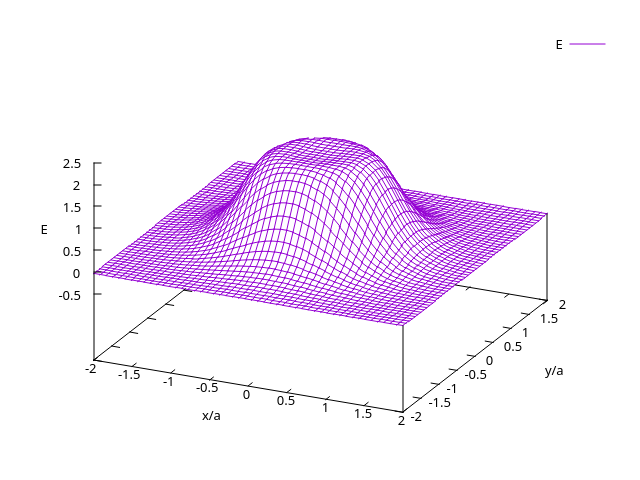
Given that the x-y plane is a conductor at zero potential. A point dipole p = p k is placed
on the z-axis at z=a.

k is the unit vector in the z-direction.

(a) Find the image of the dipole. [Hint: Break the dipole into two cherges, find their images,
    then combine the charges back into dipoles.]

(b) Find the electric field at (x,y,z) for z>0.

(c) Find the electric field (magnitude and direction) at z=0.

(d) What is the charge density on the conductor?


This is what I find for the shape of the normal E-field:
(The plot away from the origin is actually slightly negative.)
- Homework 5: (Due Friday, October 31)
Given a spherically symmetric volume charge density of the form

         {  α/r for a<r<b
  ρ(r) = {
         { 0    otherwise

where r is the radial distance, and a and b correspond to two radii.

(a) Find the electric field at all radii.

(b) Find the electrostatic potential at all radii.

(c) Find the electrostatic energy density uE(r).

(d) Find the total electrostatic energy.
- Homework 6: (Due Friday, November 7)
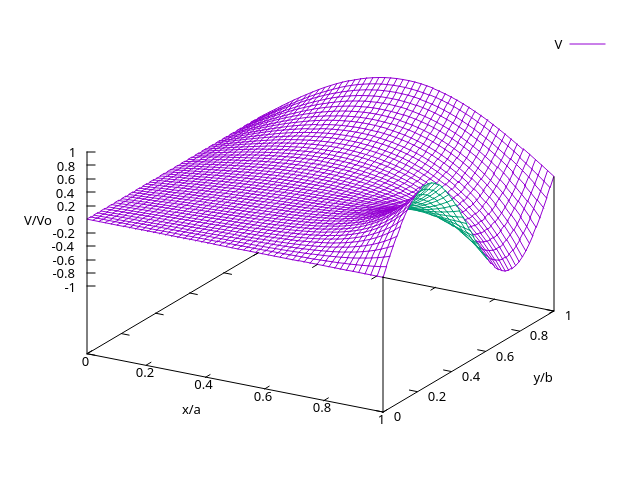
We need to find the potential in a rectangular region bound by the
coordinates 0<x<a and 0<y<b.

The potential at the boundaries of the region are given as

  V(x,0) = 0

  V(x,b) = Vo sin(πx/a)

  V(0,y) = 0

  V(a,y) = Vo sin(2 πy/b)

Find the potential V(x,y) in the region 0<x<a and 0<y<b.

This is what I get:
- Homework 7: (Due Friday, November 14)
We need to find the potential in a cylindrical region bound by the
coordinates r<ρ<R. There is no variation in the z-direction.

The potential at the boundaries of the region are given as

  V(ρ=r,φ) = Vo cos(φ)

             {  Vo  for 0<φ<π
  V(ρ=R,φ) = {
             { -Vo  for π<φ<2π

Find the potential V(ρ,φ) in the region r<ρ<R.
- Homework 8: (Due Friday, November 28)
(a) A uniform line charge (with charge λ per unit length) extends from z=-a to z=+a
    on the z-axis.

    (i)   Find the potential on the z-axis for z>a.
    (ii)  Expand this expression in powers of 1/z. Determine the first 4 finite coefficients.
    (iii) Generalize this series to find the potential off the z-axis: V(r,θ).
    (iv)  Interpret the values of the first two coefficients (ℓ=0 and ℓ=1) in the series, in relation to the
           type of charge densities that would produce the corresponding asymptotic dependence in powers of 1/r.

(b) Repeat part (a) for a non-uniform linear charge density with λ=αz between z=-a and z=+a
    on the z-axis. (α is a constant.)
- Homework 9: (Due Friday, December 5)
A non-uniformly polarized spherical dielectric sphere of radius R is placed at the origin.
The polarization density of the sphere is given by P = po z k
where po is a constant and k is the unit vector in the z-direction.

  (a) Find the volume and surface bound charges.

  (b) Find the potentials due to the volume and surface bound charges separately and add them
      to find the total potential.

  (c) Interpret your result.
- Homework 10: (Due Monday, December 22)
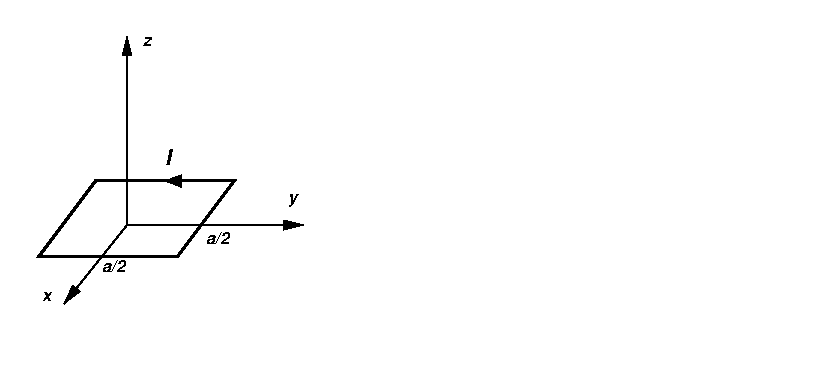
A square loop of wire (sides of length a) carrying current I is placed on the x-y plane and
centered at the origin as shown in the figure. Find the magnetic field on the z-axis and
discuss its asymptotic behavior for large values of z.
Each homework is to be placed as a single PDF document (which may contain photos of your work) and submitted through moodle.
Please name the file in the format: