- Homework 1: (Due Friday, Sep. 22)
  For this homework, do not use any vector calculus theorems to simplify the algebra, complete
  the differentiation and integration operations as instructed in the problems.

  This first homework is intended to remind you of the vector calculus operations
  we will use throughout this course. If you are having difficulty carrying out the
  operations, I reccommend a fast review of the relevant topics.


  A tetrahedral volume V is defined by its 4 corners O, A, B and C with the x-y-z coordinates

  O : 0, 0, 0
  A : 2, 0, 0
  B : 0, 2, 0
  C : 0, 0, 3

  The triangular surfaces S1, S2, S3 and S4 are defined by their corners

  S1 : OAB
  S2 : OAC
  S3 : OBC
  S4 : ABC

  with their directions pointing outside V.

  1) Find the unit vectors in the directions of S1, S2, S3 and S4.

  2) Consider the function v(x,y,z) = x3y2z2.

     (a) Find its gradient E = ∇ v

     (b) Find its laplacian ρ = ∇2 v

     (c) Find the curl of E:   C = ∇ x E

     (d) Integrate ρ within the volume V:     Q = ∫V ρ d3x

     (e) Integrate E along the edge of surface S4:     I = ∮ABCA E ⋅ dl

     (f) Integrate E on the surfaces Si to find its flux through these surfaces: Φi = ∫Si E ⋅ dS

     (g) What is the total flux  Φ1 +  Φ2 +  Φ3 +  Φ4 ?


  3) Consider the vector field A = i x2yz + j xy2z2 + k x3yz2
     where i, j and k are the unit vectors in the x, y and z directions respectively.

      (a) Find the curl of A :     B = ∇ x A

      (b) Find the curl of B :     j = ∇ x B

      (c) Find the flux of j through surface S4 : I4 = ∫S4 j ⋅ dS

      (d) Integrate B along the edge of surface S4:     i4 = ∮ABCA B ⋅ dl
- Homework 2: (Due Friday, Sept. 29)
  Two line charges are placed on the z-axis, the first one (with charge density -λ per unit length)
  extends from  z=-2a to z=-a and the second one  (with charge density λ per unit length)
  extends from z=a to z=2a.

  (a) Find the electric field at a general point (x,z) on the x-z plane.
      Using symmetry arguments, state the direction of the electric field
      on the z and x axes.

  (b) Find the asymptotic form of this result for

      (i)   x≫a on the x-axis

      (ii)  z≪a on the z-axis

      (iii) z≫a on the z-axis
- Homework 3: (Due Friday, October 6)
An infinitely long cylindrical charge structure has the following parts;

  o A cylindrical volume with radius R and a uniform volume charge density ρo along the
    z-axis.

  o A cylindrical surface, with radius 2R, which carries a uniform surface charge density -σo
    coaxial with the volume charge density above.

The charge densities ρo and -σo correspond to equal but opposite amounts
of charge per unit length.

Find the energy per unit length, associated with the electrostatic field.
- Homework 4: (Due Friday, October 13)
A spherical capacitor is constructed out of two concentric spherical conducting shells
with radii a and b with a<b.

  (a) Find the capacitance C.

  (b) If the two conductors carry charges +Q and -Q, find the energy stored in the
      system by integrating the energy density in the electrostatic field.
      Express your result in terms of Q and C.
- Homework 5: (Due Friday, October 20)
A conducting sphere of radius R is placed at the origin and kept at zero potential.

A point dipole of magnitude p and in the +z direction is placed on the z-axis
at z=a, with a>R.

Find the potential at a general point outside the sphere.

Warning: You will need to find the image of the dipole inside the sphere. Represent
the dipole as two point charges a finite distance apart, find their images, and then
evaluate the limiting case when the two charges become a point dipole. You will notice
that the image of the dipole is not simply another dipole!
- Homework 6: (Due Friday, November 3)
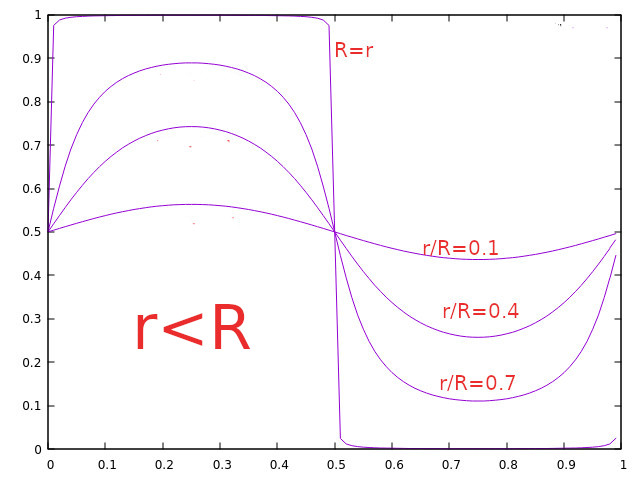
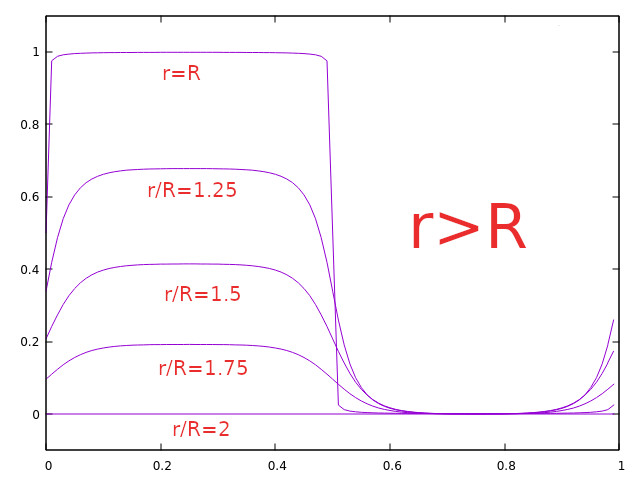
A thin cylindrical shell with radius R is placed with is axis on the z-axis
and is kept at a potential such that

                       { 0  for  0 < φ < π
               V(φ) =  {
                       { Vo  for  π < φ < 2π .

A second cylindrical shell with radius 2R is kept at zero potential.

  (a) Find the potential as a function of the radial distance 0 < ρ < 2R and the angle φ.

  (b) Plot this potential, keeping sufficient number of terms in the series.


This is what I get for the potential (V/Vo vs φ/2π).
- Homework 7: (Due Friday, November 10)
A spherical conducting shell with radius 2R is centered at the origin
and is kept at a contant potential Vo. A thin surface layer of spherical charge
with radius R, also centered at the origin has charge density

               σ(θ) =  σo cos(3θ)

where σo is constant.

  (a) Find the potential as a function of the radial distance 0<r<2R and the angle θ.

  (b) Plot this potential.
- Homework 8: (Due Friday, November 17)
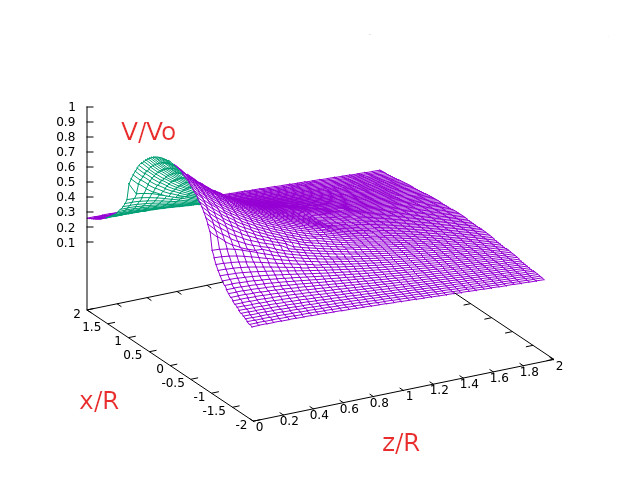
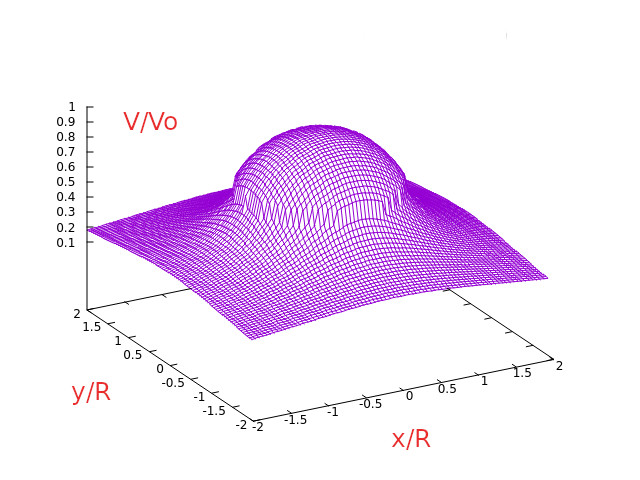
A thin charged disk of radius R is placed on the x-y plane, centered at the origin.

  (a) Find the eletrostatic potential on the +z axis.

  (b) Expand the result in powers of z for z>R and z-1 for R>z, keeping 5 finite terms in the series.

  (c) Use the results in part (b) to obtain a series expansion for the potential as a function of r and θ.

  (d) Plot the potential on the x-z plane.

  Here is what I get for V/Vo on the x-z and the x-y planes, where Vo is the potential at the center of the disk.
- Homework 9: (Due Monday, December 11)
  (a) Consider a general vector A(x,y,z) = i Ax(x,y,z) + j Ay(x,y,z) + k Az(x,y,z)
      where i, j, k are the unit vectors in the x, y and z directions.

      (i)  Calculate the curl of A:  B = ∇ × A.

      (ii) Calculate the divergence of B:   ∇ ⋅ B.

  (b) A rectangular (size a × b) wire carrying current I is on the x-y plane. Place it in
      any position that you find convenient. There is a uniform magnetic field B = Bo n acting
      on the loop. ( n is a general unit vector.)

      (i)  Find the total force acting on the loop.

      (ii) Find the torque acting on the loop and verify that it can be expressed in terms of the
           magnetic moment and the field.
- Homework 10: (Due Monday, December 18)
A circular loop of wire carrying current I1 and with radius R is placed on the x-y plane, centered
on the y-axis at y=a. (Take R<a.) An infinite straight wire carrying current I2 is placed on the
x-axis. Find the force acting on the circular loop. (You can look up the integral.)
Each homework is to be placed as a single PDF document (which may contain photos of your work) and submitted through moodle.
Please name the file in the format: